
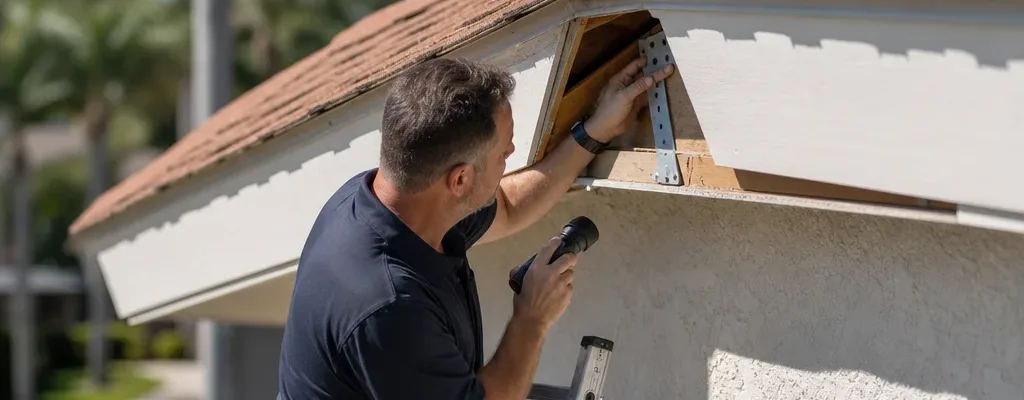
What a Third Nail Retrofit Inspection Verifies
A Third Nail Retrofit Inspection checks that the extra nails were added to the metal clips holding your roof to your walls. It also checks that they were driven where they hold and that the work covers the whole roof, not just the easy spots. If the attic doesn't show that clearly, the upgrade may not earn a better rating on your insurance paperwork.
First, a quick word on what the retrofit is. In a lot of older Florida homes, the roof trusses are tied to the walls with metal clips. Many of those clips were installed with only two nails. The state wind mitigation form only counts a connection as a clip when it has at least three nails. With fewer, it's rated the same as toe nails, the weakest option on the form. A third nail retrofit adds one more nail to each clip so the connection can earn the clip rating, which insurers use to set wind discounts.
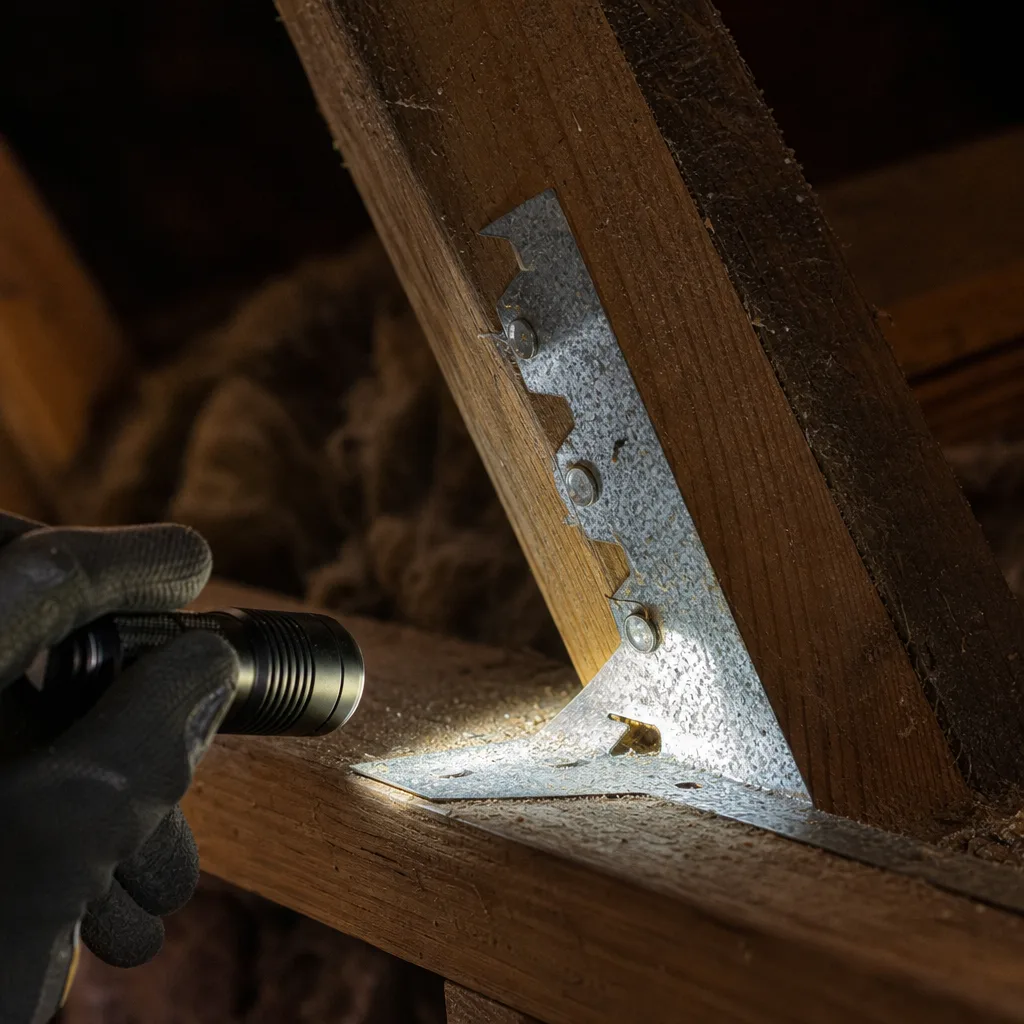
The inspection is how you prove the work got done. Saying it was done isn't enough. Here's what has to check out up in the attic:
- The third nail is really there. Every clip the inspector can reach should show the added nail, not just a few near the attic hatch.
- The nail is in the right spot. It has to go through the clip and into solid wood, the truss or rafter and the top of the wall. A nail that missed the wood or split it doesn't add real holding power.
- The right kind of nail was used. A short or skinny nail driven in to fill a hole isn't the same as a proper fastener sized for the job.
- The work is consistent across the house. An insurer wants to know the whole roof is tied down the same way. A few good clips over the garage don't help much if the rest of the house was skipped.
- There's clear evidence. The findings need to be documented well enough that an underwriter reading the report can see what's in your attic without going up there.
Some homes make this harder to confirm. Low-slope roofs, tight attic spaces, blown-in insulation piled over the top of the walls, or framing hidden behind ductwork can block the view of the clips. When an inspector can't see enough connections to be sure, the honest answer is to report what was seen and what wasn't. Guessing would get you a rating that falls apart if the insurance company asks questions later.
Jamie spent many years in residential and commercial construction, so we know the difference between a nail that's holding something and a nail that's just there. Retrofit work done in a hot attic in a hurry can go either way. Some clips get done right, and some get missed or nailed into air. That's exactly what this inspection is meant to catch, before you count on a discount that the attic won't back up.
Once the connections check out, the results feed into your Wind Mitigation Inspection. That's the report your insurance company reads when it sets your wind discount.
Why Insurers Request This Inspection
Your insurance company asks for this inspection for one simple reason. It's about to give you a discount, and it wants proof before it does. A contractor's invoice says work was done. It doesn't show that every clip got a nail in solid wood. The insurer is pricing your policy on what's really in your attic, not on what someone says is there.
The roof-to-wall connection is one of the biggest items on a wind mitigation report. When a hurricane comes through, the wind pushes up on the roof from below and pulls at it from above. If the roof lifts off, rain pours into the house, and a small claim turns into a total loss. Insurers know this. That's why a stronger connection rating can move your wind premium more than a lot of other features on the form.
Here are the common times an insurer asks for this kind of proof:
- Right after a retrofit, when you want the new rating applied to your policy.
- At renewal, if your old wind mitigation report is out of date or the insurer wants a fresh look.
- When you switch to a new insurance company that won't accept another carrier's paperwork as is.
- When you're buying a home and need coverage in place before closing.
- During an underwriting review, when the insurer questions a rating that's already on file.
That last one is the one that catches people off guard. An insurer can send its own inspector out to check what your report claims. If that person goes up in the attic and finds clips that were skipped or nails that missed the wood, the discount can come off. You could end up paying more than you planned, and you'd have paid for a retrofit that didn't earn its keep.
This matters a lot in Citrus County. Plenty of homes around Inverness were built before Florida tightened its building code, so their roof connections started out on the weaker end. Those are the homes where a retrofit can make a real difference in what you pay. They're also the homes where an insurer is most likely to want solid proof before it changes your rating.
Timing is part of it too. Hurricane season runs from June through November, and insurance deadlines don't wait for a convenient week. If you need the rating updated before a renewal date or a closing, you want the inspection done early. That leaves room to fix a missed clip before the paperwork goes in.
So when your insurer asks for this, don't take it as a hassle or a sign they think you're hiding something. It's their way of saying they'll give you credit once they can see it. A clear, well-documented inspection gives them what they need and puts the discount on firm ground. That way it holds up if anyone ever comes back to check.
Confirm Your Inspector Can Complete the State Mitigation Form
A great attic check won't help you if the person who did it can't put the results on the right paperwork. Florida insurers use a standard state form for wind mitigation. The roof-to-wall connection is one of the boxes on that form. If the form isn't filled out and signed by someone the state allows to sign it, your insurer can simply set it aside. Then your third nail retrofit sits up there doing its job in a storm while your premium stays the same.
The form itself lists the kinds of professionals who can sign it. Licensed home inspectors, licensed contractors, engineers, and architects are among them. A handyman, a roofer's helper, or the crew that drove the nails can't sign off on their own work. That's the point. The insurer wants someone qualified who didn't do the job to say what's really there.
Signing isn't the whole story, either. Insurers usually want clear photos that back up each answer on the form. For the roof-to-wall box, that means pictures of the clips and the nails, taken in more than one spot in the attic. A report that checks the box but shows one blurry clip near the hatch is the kind that gets questioned later.
Before you book anyone, ask a few plain questions:
- Are you licensed to sign the state wind mitigation form, and what's your license number?
- Will you photograph the roof-to-wall connections in several places, not just one?
- Will you complete the whole form, or only the roof-to-wall section?
- If you can't see enough clips to be sure, will you tell me that plainly instead of guessing?
- How soon will I get the report, and can I send it straight to my insurance agent?
On cost, it helps to know how this usually works. The retrofit check is part of the wind mitigation report, not a separate trip, so ask whether it's included in that price. Things like a hard-to-reach attic or a home far out of town can affect what an inspector charges. If you also need a 4-Point Inspection or a Roof Certification for the same policy, ask about doing them on the same visit. One trip into the attic is easier on your schedule and your closing date.
JD Inspections is a Florida licensed home inspector, license HI9000, and you're welcome to look that number up before you call. We do wind mitigation inspections here in Inverness and across Citrus County. We'll fill out the state form and give you a report you can read. If something in your attic doesn't measure up, we'll tell you what it is and what it would take to fix it before the form goes to your insurer.
Pairing This Inspection With Wind Mitigation or a 4-Point Visit
The third nail check doesn't stand on its own. It's one answer on your wind mitigation report, so the two always go together. The real question is whether your insurer wants anything else from the same house. On older homes it often does.
A 4-Point Inspection checks the roof, electrical, plumbing, and HVAC so your insurance company can decide whether to cover the home at all. It asks a different question than wind mitigation. Wind mitigation is about how the house is built to stand up to wind. A 4-point is about the shape those four systems are in today. A Roof Certification is narrower still. It looks at the roof's condition and how much life it likely has left.
Here's a common picture in Inverness. Someone from up north is buying a block home built decades ago. The seller had a third nail retrofit done to help with insurance. The buyer's agent says the insurer wants a wind mitigation report and a 4-point before it will write the policy, and closing is three weeks out. Booking those on separate days means two trips, two waits for reports, and more chances for a deadline to slip. If they're scheduled together, the attic, the roof, the panel, and the water heater all get looked at while someone is already there.
If you don't know what your insurer needs, ask your agent this one question: "Which inspections do you need, and by what date?" Get the answer in writing if you can. Then you're booking for the real list, not a guess.
Whatever you book, a little prep goes a long way:
- Clear a path to the attic hatch, and move anything stored right under it.
- Make sure the electrical panel isn't blocked by shelves or boxes.
- Leave the water heater and the air handler reachable.
- Find any paperwork for the retrofit, the roof, or past repairs, like invoices or permit numbers.
- If you know the roof's age, write it down. It matters on more than one of these reports.
There's one thing these inspections can't do. None of them can tell you if there's a sinkhole under the house. Citrus County buyers ask about that a lot, and it's a fair worry. It's just a separate question that needs a different kind of specialist. We'd rather tell you that up front than let you think a 4-point covered it.
If you've served in the military or you're a veteran, thank you. Ask about our military and veteran discount when you call.
When You May Not Need a New Inspection
Not everyone who calls about this needs a new inspection right now. Sometimes the right move is to use the paperwork you already have, or to wait a bit. Here's when we'd tell you to hold off.

- Your current wind mitigation report already shows the stronger roof-to-wall rating, and nothing in the attic has changed since. If your insurer still accepts that report, a new one just repeats what's on file. In Florida, a wind mitigation report is generally good for up to five years, as long as nothing on the house has changed. Ask your agent to confirm yours is still on file.
- The retrofit isn't finished yet. An inspection done before the work is complete will only confirm the old, weaker rating. Wait until the contractor tells you every clip is done, then book.
- Your roof is getting replaced soon. If a new roof is coming in the next few months, it usually makes sense to wait. That way one report covers the new roof and the attic connections together, and you're not paying twice for paperwork that goes stale fast.
- Your home already has the connection a third nail would give you, or a stronger one. Some homes, often newer ones built under Florida's tougher code, were built with clips that already have enough nails, or with wraps that rate even higher. In that case, the third nail question doesn't change anything on your form.
- Your insurer won't give much credit for it. Discounts vary by company and policy. If the savings your agent quotes are small, the inspection may not pay for itself this year.
That last one is worth a phone call before you spend a dime. Ask your agent, "If my roof-to-wall rating goes up, about how much does my wind premium drop?" Get a real number. If it's worth a lot, book the inspection. If it's not, you've saved yourself the trouble.
Here's a picture that comes up around Inverness. A couple had a full wind mitigation report done last spring when they bought their house. Their insurer applied the discount, and they haven't touched the roof or the attic since. Now a renewal letter shows up and they worry they need to start over. Most of the time the honest answer is to call the agent first. If the insurer is happy with last year's report, there's nothing new for an inspector to find.
There's one case where you shouldn't wait, even if your paperwork looks fine. If a storm, a roof leak, or a repair crew has been working in your attic, the connections may not match what your old report says. A big storm can loosen clips. A roofer or an AC tech can pull a clip loose or move insulation around. If your insurer ever checks, it'll judge the attic as it is today, not as it was when your report was written.
We'd much rather you skip an inspection you don't need than pay for one that changes nothing. When you do need one, you'll know it's for a real reason.
Frequently Asked Questions
How long does a third nail retrofit inspection take?
It depends on how easy your attic is to access and how many clips need checking. A simple attic with clear access goes faster, while low-slope roofs or attics packed with blown-in insulation take more time to check each connection. It's checked during your wind mitigation inspection, so it doesn't need a separate trip.
What happens if the inspection finds a clip that was missed?
You'll get a clear report showing which clip didn't pass and why, so you know exactly what to tell your contractor. The report notes whether a nail missed solid wood, split the wood, or was simply never added. That way you can get the specific clip fixed instead of redoing the whole roof.
Can I be in the attic while the inspection happens?
Yes. You're welcome to come up into the attic with us and see the clips for yourself. Step only on the framing, since the ceiling below won't hold your weight. Clearing a path to the attic hatch ahead of time helps the check go smoothly.
Does the retrofit inspection check anything besides the roof clips?
No, it only checks the roof-to-wall connections, since that's the one item on the wind mitigation form the retrofit affects. If you also want your roof, electrical, plumbing, or HVAC looked at, that's a separate 4-Point Inspection, which can be done on the same visit.
My older Inverness home doesn't have a third nail retrofit. Should I still get it inspected?
If the retrofit hasn't been done, there's nothing yet to inspect and document. But many older, site-built homes in established parts of Inverness predate modern roof-to-wall codes and may already have the upgrade done without the paperwork. If yours might qualify, it's worth confirming so you don't miss a credit.